There’s a shift that happens in the final phase before a global event.
Planning gives way to execution.
Forecasts turn into signed agreements.
And what sat in draft form for months suddenly becomes urgent, real, and time sensitive.
That’s where businesses operating around Houston are right now.
The World Cup is no longer a distant opportunity. It’s an active marketplace. Deals are being finalized across hospitality, logistics, security, infrastructure, and vendor partnerships. Many of them are happening under compressed timelines, where decisions are measured in hours, not weeks.
In this environment, one overlooked factor is quietly determining who moves forward and who stalls: language readiness.
The Hidden Pressure Behind Last-Minute Deals
Last-minute deals are not unusual in global events. In fact, they are expected.
As timelines tighten, availability shifts. Vendors change. Pricing adjusts. New partnerships emerge quickly to fill gaps or capitalize on opportunities. Businesses that can respond immediately often gain an advantage.
But speed introduces complexity, especially when those deals involve international stakeholders.
A contract drafted overseas.
A supplier agreement issued in another language.
Compliance documents tied to regulations outside the U.S.
These are not uncommon scenarios. They are part of doing business globally.
The pressure comes from the need to make fast decisions without compromising accuracy.
Why Language Becomes a Bottleneck
Most organizations are prepared for operational scale. They plan for staffing, supply chains, and logistics.
What they don’t always plan for is how language impacts decision-making speed.
When a document arrives in a language your team does not fully understand, everything slows down:
- Legal review is delayed
- Internal approvals stall
- Negotiations lose momentum
- Risk increases due to incomplete interpretation
Even a short delay can mean losing a contract or missing a strategic opportunity.
This is not a translation issue in the traditional sense. It’s a business continuity issue.
The Difference Between Translation and Interpretation of Risk
There is a tendency to treat translation as a task rather than a function.
But in high-stakes environments, translation directly influences risk.
Legal documents are structured with precision. Terms around liability, payment schedules, dispute resolution, and compliance are intentionally detailed. When these are translated incorrectly or interpreted loosely, the consequences are not minor.
They can affect:
- Financial outcomes
- Legal exposure
- Operational expectations
- Long-term partnerships
This is especially critical in industries supporting large-scale events like the World Cup, where contracts often involve multiple parties across different jurisdictions.
Understanding what you agree to is not optional. It is foundational.
Strategic Preparedness in a Compressed Timeline
Preparedness, at this stage, is not about having more time. It is about having the right systems in place to operate within a limited time.
Businesses that are navigating this period effectively tend to share a few characteristics:
They anticipate the need for rapid document review.
They establish clear processes for handling international agreements.
They rely on specialized partners instead of improvising under pressure.
This allows them to respond quickly without sacrificing clarity or accuracy.
In contrast, businesses that treat language as an afterthought often find themselves reacting instead of leading.
Speed and Accuracy Are Not Opposites
There is a common misconception that fast turnarounds and high accuracy cannot coexist.
In reality, the ability to deliver both is what defines operational readiness.
Speed without accuracy introduces risk.
Accuracy without speed introduces delays.
In the context of last-minute World Cup deals, neither is acceptable.
What is required is a structured approach to translation that prioritizes both, ensuring that documents are delivered quickly and reflect the exact intent of the original content.
This is particularly important for:
- Contract translations
- Legal agreements
- Compliance documentation
- Vendor and partnership terms
Each of these carries implications that extend beyond the immediate deal.
The Competitive Advantage of Clarity
When timelines are tight, clarity becomes a competitive advantage.
Businesses that fully understand their agreements can:
- Negotiate more effectively
- Approve deals faster
- Reduce back-and-forth with partners
- Execute with confidence
They are not second-guessing terms or revisiting decisions after the fact. They are moving forward with certainty.
This level of clarity is not achieved through guesswork or informal translation. It requires a deliberate, professional approach.
A Moment That Rewards Prepared Businesses
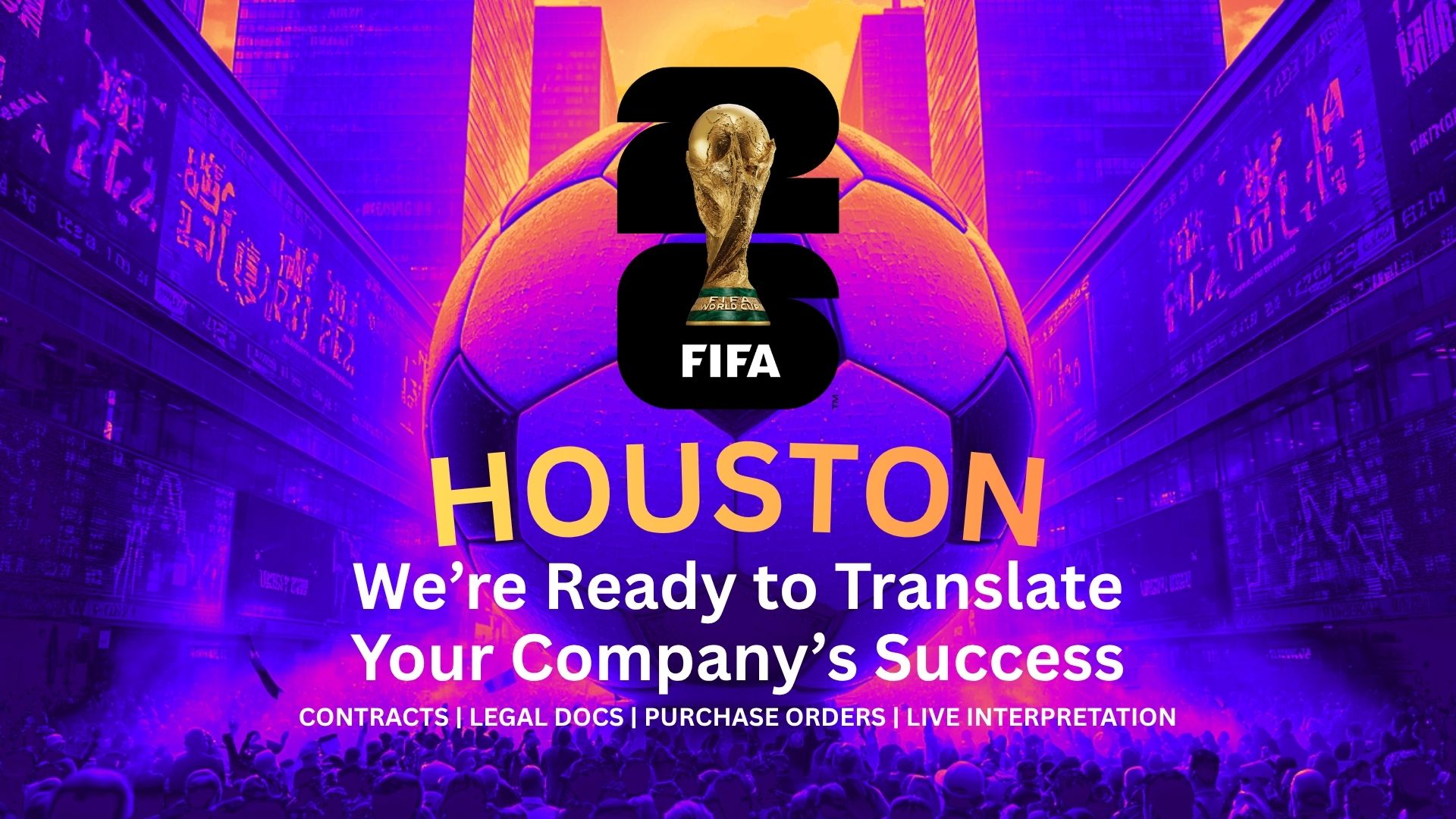
The FIFA World Cup 2026 represents more than a series of matches. It is a concentrated period of global economic activity.
For businesses in Houston, this is an opportunity to engage with international markets in a way that may not be available again at this scale for years.
But opportunity does not wait for perfect conditions.
It rewards those who are ready to act.
And readiness, in this context, includes the ability to navigate language without hesitation.
Moving Forward with Precision
As deals continue to move quickly, the question is not whether your business will encounter language barriers.
It is how you will handle them when they appear.
Will they slow you down?
Or will you have the capability to move through them with speed and confidence?
GlobalSpeak Translations supports businesses during these high-pressure moments by providing fast, accurate translation of contracts and legal documents, allowing decisions to be made without delay or uncertainty.
Contact us at 844-557-7325.
Visit the website: https://globalspeaktranslations.com/